Four Slices of the Pizza
What Your Commercial Roofing Proposal Actually Pays For

🔲 Every proposal is four things, not one. Materials. Labor. Operating expenses. Net. When a contractor hands you a lump sum, they combined all four and removed your ability to question any of them.
🔲 Half your money is materials, and every dollar is verifiable. AI tools can pull current distributor pricing for any commercial roofing product in minutes. If a contractor won't itemize by product name and unit cost, ask yourself what they're protecting.
🔲 Suspiciously low labor isn't a deal. It's a risk. Below-market crews mean skipped insurance, unverified workers, and liability that lands on your property, not theirs.
🔲 10% net isn't the owner's vacation fund. It covers warranty callbacks, equipment replacement, slow seasons, and team retention. A company squeezed below that margin may not be around to honor what they signed.
It is not one number.
When a roofing company hands you a proposal, the total at the bottom is not one thing. It is four things combined into a single line. Most companies prefer it that way. One lump sum. No breakdown. No questions. Just sign.
That approach works in their favor. Not yours.
Every legitimate commercial roofing company operates within the same four categories. The percentages shift slightly depending on scope and complexity, but the categories are always identical. If you understand these four slices, you can evaluate any proposal from any contractor in Hammond, Portage, Hobart, or anywhere in Lake and Porter Counties with clarity instead of guesswork.
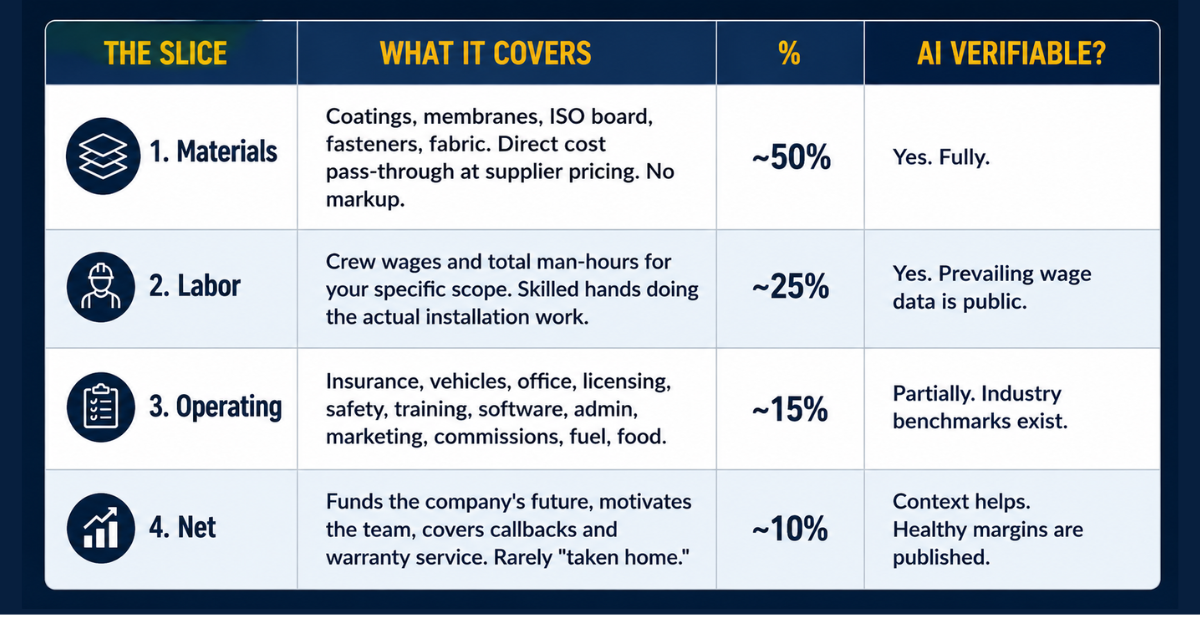
That is the whole pizza. Four slices. Nothing hidden. Nothing mysterious.
Slice 1: Materials (About 50%)
Cost pass-through. Period.
Materials are materials. The coatings, membranes, ISO insulation board, fasteners, reinforcing fabric, adhesives, and primers cost what they cost. A roofing company purchases them from a distributor or directly from the manufacturer at a published price and passes that cost to you. There is no markup magic here. There should not be.
This is the most researchable slice of the entire pizza. AI tools can pull current distributor pricing for nearly any commercial roofing product on the market. You can verify in minutes whether a proposal's material line reflects actual cost or has been inflated. You can check whether the products specified are premium-grade Conklin acrylics or watered-down substitutes. You can confirm whether the coverage rates match what the manufacturer requires for full warranty compliance.
Ask your contractor to itemize materials by product name, quantity, and unit cost. If they will not, that tells you something worth paying attention to. A company that trusts its own pricing has no problem showing you the receipt.
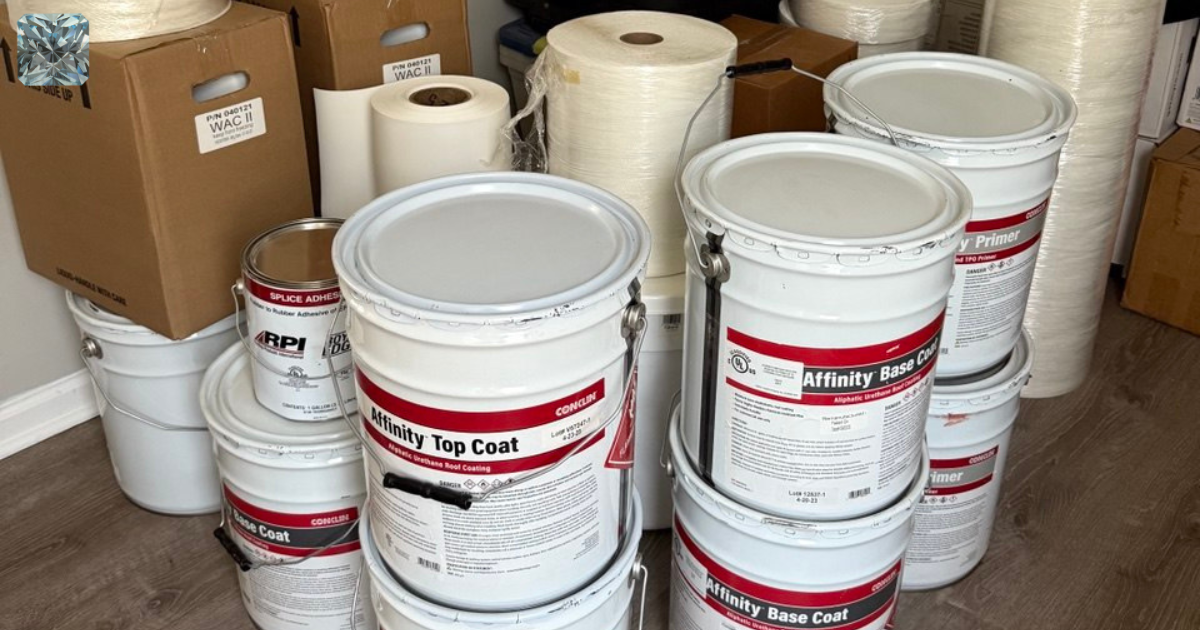
Fifty percent of your project cost sits in this category. Half your money. And every dollar of it is verifiable by anyone willing to spend ten minutes with an AI tool and a manufacturer spec sheet.
Slice 2: Labor (About 25%)
Revealed. Not veiled.
Labor is a completely different category from materials. Do not let anyone blend them. When a company lumps materials and labor into one line item, they are hiding the math. That is not an accident. That is a choice.
Skilled commercial roofing labor in Northwest Indiana has a prevailing rate. Union rates are published. Non-union rates follow a regional range. A company that reveals their labor rate and total man-hours for your specific project is a company that trusts its own numbers. A company that hides it is hoping you will not ask.
Our top-line billable labor rate is $42 per hour. What a company charges the client is not the same as what the company pays the worker. There are payroll taxes, workers compensation insurance, benefits, and supervision layered into that number. But the number itself should not be a secret.
What the company chooses to pay their workers does not always reflect what the company charges you. That spread covers real costs: payroll tax, workers comp, training, supervision, and the margin required to retain skilled people. But the top-line rate should be on the table. You should be able to see it, verify it against prevailing wage data, and decide if it reflects the quality of crew you want on your building.
Pay market rate to get at least average results. Pay below market to attract below-average hands. That math is simple and it plays out on every roof, every time.
There is also a legitimate due diligence question about crew qualifications that goes beyond skill level. There is a real risk associated with hiring workers who are not authorized to work in the United States. Contractors who dramatically undercut the market on labor are sometimes doing so by sidestepping crew verification, insurance requirements, and legal compliance. That liability does not stay with the contractor. It lands on the property. If labor rates on a proposal look suspiciously low, the follow-up question is not "how did they find that savings" but rather "what did they skip."
Slice 3: Operating Expenses (About 15%)
Companies have to breathe.
Operating expenses are genuine. They are constant. They exist whether the company installs one roof this month or twenty. This is the cost of a company being legal, insured, trained, equipped, and organized enough to serve you properly.
Here is what that 15% actually covers:
General Liability & Workers Comp Insurance
Licensing & Permits
Fleet Vehicles & Fuel
Office Rent or Virtual Office
Safety Equipment & Training (OSHA)
Software: CRM, Estimating, Accounting
Administrative Staff
Legal & Accounting
Marketing & Advertising
Sales Commissions
Uniforms & Branding
Continuing Education & Certifications
The commercial roofing industry typically runs between 25% and 33% total operating expenses. A company that runs lean and efficient can operate closer to 15%. That is not padding. That is infrastructure. That is the reason your contractor answers the phone on a Monday, has insurance when something goes wrong, and shows up with crews who were trained last month instead of last decade.
A company with no operating expenses is a company with no insurance, no safety program, no training, and no office. That is not a bargain. That is a liability sitting on your roof.
If you are a facility maintenance manager who shops vendors across multiple trades, this category is the one that separates legitimate operations from guys with a truck and a prayer. Electrical, painting, blacktop, roofing, HVAC. The operating cost structure is similar across all of them. A company that cannot explain where the 15% goes probably does not have a 15%.
Slice 4: Net (About 10%)
Not what you think.
Net margin sounds like profit. It sounds like the owner is pocketing ten cents of every dollar. That is almost never the reality.
Net margin partially motivates leadership and everyone on the team. It funds equipment purchases and replacements. It covers callbacks and warranty service calls that produce zero revenue. It builds the reserve that lets the company survive a slow quarter without laying off the crew you need next Spring. And the portion that actually gets "taken home" is so very rarely truly taken home. It goes back into the company. Into the team. Into the ability to show up and perform next month.
Ten percent net on a commercial roofing project is not extravagant. It is survival. A company operating on thinner margins than that is one bad month away from not being around to honor your warranty. And a company significantly above 10% in a competitive free market? That is worth a conversation. Not an accusation. Just a question.
Margin is not margin. There are many hard costs eating from that small slice of pie. The gap between gross margin and what actually funds the owner's personal life is enormous. Most building owners who have run their own operation understand this instinctively. The ones who demand a contractor operate on 3% net have never run a company themselves.
Transparency Wins. Pride Hides.
Show the slices.
The companies that break their pricing into these four categories are the companies that trust their own numbers. They are not afraid of your questions because they already answered them in the proposal. They welcome scrutiny because scrutiny confirms their honesty.
The companies that give you one lump sum, refuse to itemize, and get defensive when you ask for detail are telling you something. Listen to that. Pride hides behind vague proposals and round numbers. Transparency shows up with line items and explanations.
We are going to be direct about something. We have no idea why the vast majority of commercial roofing contractors locally will not itemize their proposals and break down materials from labor. It feels like they are hiding something. And when AI tools can verify every material cost and every prevailing labor rate in about ten minutes, the hiding is not just suspicious. It is unnecessary.
If this was a quarter million dollar project and above, the accounting department would require itemization. So why does a $60,000 project get a pass? It should not. You have every right to understand where your money goes. A company that values your trust will welcome that.
The Mechanic Posts His Rate. Why Doesn't Your Roofer?
When you take your vehicle to a mechanic, the hourly shop rate is posted on the wall. $65 an hour. $85 an hour. Whatever it is, it is visible. The parts are itemized on the invoice with part numbers. The labor hours are listed. You can see exactly what you paid for and verify every line.
Commercial roofing should work the same way. Materials by product name with unit cost. Labor by rate and man-hours. Operating overhead as a percentage. Net as a percentage. Four lines. Four slices. Total transparency.
If your roofer cannot show you the four slices, ask them why. And if they will not answer that question, you already have your answer.

Want to see what a fully itemized roofing proposal looks like?
Drop your subject property address below.
Subject Property Address: ______________________________
We will email you a sample breakdown.
This Is Part of a Series
If you landed here first, start with Part 1: "Stop Googling Your Roofer: Why Research in 2026 Means AI, Not Page One Results." That article covers how to research a roofing company, how to use AI tools to verify proposals, and what happens when nobody does the due diligence. The four slices explained here are the framework. The research tools in Part 1 are how you verify them.
If you manage facilities across multiple trades, these same four categories apply to electrical, painting, blacktop, HVAC, and virtually every construction vendor you hire. A facility maintenance manager who understands this framework is not a generalist guessing at bids. They are a specialist with their finger on the pulse of every market that touches their building.
Frequently Asked Questions
What percentage of a commercial roofing proposal is materials versus labor?
In a typical commercial flat roof project in Northwest Indiana, materials account for approximately 50% of the total project cost, labor accounts for approximately 25%, company operating expenses account for approximately 15%, and net margin accounts for approximately 10%. These ratios shift slightly depending on project complexity, but the four categories remain consistent across the industry.
Should roofing materials be marked up by the contractor?
Materials should be a cost pass-through. The contractor purchases coatings, membranes, insulation, fasteners, and fabric from a distributor or manufacturer at a set price and passes that cost to the building owner. Markup on materials is not standard in transparent commercial roofing proposals. AI tools can verify current distributor pricing for virtually any commercial roofing product, making inflated material costs easy to identify.
What is a fair profit margin for a commercial roofing company?
Approximately 10% net margin is standard in commercial roofing. That margin covers equipment replacement, warranty service, callbacks, business reserves, and team retention. It is not pure owner income. A company operating significantly above 10% in a competitive market should be able to explain the premium. A company operating significantly below 10% may not have the reserves to honor long-term warranties or survive seasonal slowdowns.
Why do roofing companies give lump sum quotes instead of line items?
Lump sum quotes prevent the building owner from independently verifying material costs, labor rates, and margin percentages. Itemized proposals invite scrutiny, which transparent companies welcome and opaque companies avoid. If a contractor will not break down materials, labor, operating costs, and net as separate categories, the question to ask is what they are protecting.
What should labor cost on a commercial flat roof in Northwest Indiana?
Prevailing wage data for commercial roofing in Northwest Indiana is publicly available, and union rates are published. Non-union commercial roofing labor rates in the region typically fall within a calculable range based on crew skill level, insurance costs, and payroll overhead. What the company charges the client per hour is not the same as what the worker receives. The spread covers payroll tax, workers compensation, training, supervision, and retention. A top-line billable rate should be visible on the proposal, not hidden inside a lump sum.
How do I know if a roofing company's operating expenses are legitimate?
Legitimate operating expenses for a commercial roofing company include general liability and workers compensation insurance, fleet vehicles and fuel, licensing, safety equipment and OSHA compliance, software, administrative staff, marketing, and continuing education. Industry benchmarks for total operating expenses range from 15% to 33% depending on company size and efficiency. A company that claims very low operating expenses likely lacks insurance, safety infrastructure, or proper licensing. That is a risk, not a savings.
Your building has a story. We read roofs.
Subject Property Address: ______________________________
We will email you a free evaluation.
Materials. Labor. Operating expenses. Net. Four slices. One pizza. Total transparency. That is how a company earns your trust before they ever set foot on your roof.
Pristine Industrial Roofing
Lake County & Porter County | Commercial Flat Roofing
Conklin Coatings | Flexion Vinyl 300 | Superior Menu Options Exist